-
Sumba Sherpa (Co-Founder & CEO)
+977-9849643731
Since 1998 15,000+ Happy Guests Sherpa Owned & Operated Company
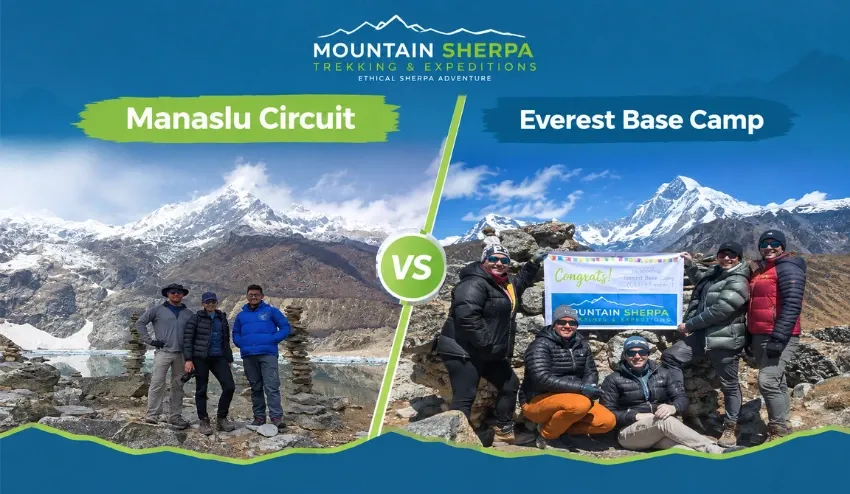
Choosing between the Manaslu Circuit and Everest Base Camp Trek is not simply a decision between two Himalayan routes. They offer two very different trekking experiences.
The Manaslu Circuit Trek takes you around Mount Manaslu, the world's eighth-highest mountain, through remote villages, deep valleys, alpine landscapes, and the challenging Larkya La Pass at 5,160 m (16,924 ft). The current MSTE itinerary is 17 days and is designed for trekkers looking for a quieter and more remote Himalayan experience.
The Everest Base Camp Trek takes you into the Khumbu region through Sherpa villages such as Namche Bazaar and Phortse, eventually reaching Everest Base Camp at 5,364 m (17,598 ft) and Kala Patthar at around 5,545 m (18,192 ft). The classic MSTE itinerary is also 17 days, but there are several other EBC options, including luxury, helicopter-supported, drive-in/drive-out and EBC-Gokyo-Cho La packages.
So, Manaslu is a strong choice if you want remoteness, quieter trails and a circuit-style adventure, while Everest Base Camp is suited to travelers whose main goal is reaching the world's most famous base camp and experiencing the Sherpa heartland of the Khumbu.
|
Feature |
Manaslu Circuit |
Everest Base Camp |
|
Region |
Manaslu / Gorkha |
Everest / Khumbu |
|
Main Mountain |
Mount Manaslu – 8,163 m (26,781 ft) |
Mount Everest – 8,848.86 m (29,031.7 ft) |
|
Standard Duration |
17 days / 16 nights |
17 days / 16 nights |
|
Main Trekking High Point |
Larkya La – 5,160 m (16,924 ft) |
Kala Patthar – around 5,545 m (18,192 ft) |
|
Trek Destination |
Manaslu Circuit |
Everest Base Camp – 5,364 m (17,598 ft) |
|
Difficulty |
Challenging |
Moderate to Hard |
|
Trek Character |
Remote circuit trek |
Classic high-altitude destination trek |
|
Daily Walking |
Around 5–8 hours |
Around 5–8 hours |
|
Crowds |
Generally quieter |
More popular |
|
Main Culture |
Gurung and Tibetan-influenced communities |
Sherpa culture |
|
Main Transportation |
Private 4WD and private vehicles |
Lukla flight for classic package |
|
Accommodation |
Mountain lodges + city hotels |
Sherpa lodges + city hotels |
|
Major High Pass |
Larkya La |
No pass required on classic EBC |
|
Best Viewpoint |
Larkya La / Manaslu region |
Kala Patthar |
|
Best For |
Remote Himalayan adventure |
Everest experience and Sherpa culture |
The Manaslu package lists a maximum altitude of 5,160 m, 17 days, 5–8 hours of daily walking, and challenging difficulty. The classic EBC package lists 17 days, 5–8 hours of daily walking, and moderate-to-hard difficulty.

The Manaslu Circuit Trek is a 17-day journey around Mount Manaslu at 8,163 m (26,781 ft).
The route begins with a private 4WD journey from Kathmandu toward Soti Khola and then follows the Budhi Gandaki Valley through forests, waterfalls, suspension bridges and traditional mountain villages.
As you gain altitude, the landscape changes from green valleys to alpine terrain. The route passes through places such as Jagat, Deng, Namrung, Samagaon and Samdo before reaching Dharamsala and eventually crossing Larkya La Pass at 5,160 m (16,924 ft).
The current package includes an acclimatization day in Samagaon, where trekkers can choose an optional hike toward Birendra Tal or the Manaslu Base Camp area depending on their condition and walking pace.
The route is described by MSTE as challenging and generally requires around 5–8 hours of walking per day.
If you want to study the route in more detail, see the Manaslu Circuit Trek and the detailed Manaslu Circuit Trek itinerary.

The Everest Base Camp Trek follows the classic route through Nepal's Khumbu region toward the base camp of Mount Everest.
The current MSTE classic itinerary is 17 days and 16 nights and begins with a flight to Lukla before continuing through Phakding, Namche Bazaar, Phortse, Pangboche, Dingboche, Lobuche and Gorakshep.
The trek reaches Everest Base Camp at 5,364 m (17,598 ft). Trekkers also climb Kala Patthar for one of the closest panoramic viewpoints of Mount Everest, with the article's commonly presented elevation being around 5,545 m (18,192 ft).
The route combines high-altitude trekking with Sherpa culture, mountain monasteries, traditional villages and views of peaks including Everest, Lhotse, Nuptse and Ama Dablam.
The current MSTE itinerary also includes less-traveled sections around Phortse and an Ama Dablam Base Camp hike at about 4,600 m (15,091 ft).
For the main package, see the Everest Base Camp Trek.
The biggest difference is the character of the journey.
Manaslu is a true circuit trek. You travel through different valleys and communities, gradually cross into high alpine terrain, cross Larkya La and descend on the other side.
The route is quieter and more remote, with fewer facilities in some sections.
EBC is primarily a destination-focused trek.
You travel into the Khumbu, acclimatize along the way and continue toward Everest Base Camp and Kala Patthar before returning through the same general region.
The route has more established lodges, shops, restaurants, and trekking services.
Interestingly, the standard packages are almost identical in duration.
17 days / 16 nights
The itinerary includes Kathmandu sightseeing, the drive to Soti Khola, the complete circuit, acclimatization at Samagaon, Larkya La crossing, and return to Kathmandu.
17 days / 16 nights
The itinerary includes Kathmandu, Lukla, Phakding, Namche, Phortse, Pangboche, Dingboche, Lobuche, Gorakshep, Everest Base Camp, Kala Patthar, and the return to Lukla and Kathmandu.
However, EBC gives you more choices if you have different time or comfort requirements.
|
EBC Package |
Duration |
Main Difference |
|
Classic EBC Trek |
17 Days |
Traditional Lukla-to-EBC trek |
|
Luxury EBC Trek |
16 Days |
Premium accommodation and comfort |
|
Luxury EBC + Helicopter Return |
13 Days |
Helicopter return after EBC and Kala Patthar |
|
EBC Round-Trip Helicopter |
17 Days |
Helicopter Kathmandu–Lukla–Kathmandu |
|
EBC Without Lukla Flight |
21 Days |
Drive to and from the Everest region |
|
EBC + Gokyo + Cho La |
20 Days |
EBC combined with Cho La and Gokyo |
This range makes Everest Base Camp particularly flexible for travelers with different schedules and preferences.
Altitude is one of the most important differences.
|
Altitude Point |
Manaslu |
Everest Base Camp |
|
Main mountain |
Manaslu – 8,163 m / 26,781 ft |
Everest – 8,848.86 m / 29,031.7 ft |
|
Main trekking destination |
Larkya La – 5,160 m / 16,924 ft |
EBC – 5,364 m / 17,598 ft |
|
Highest viewpoint |
Around Larkya La |
Kala Patthar – around 5,545 m / 18,192 ft |
The EBC route reaches a higher trekking elevation than the Manaslu Circuit.
However, higher does not automatically mean harder.
Difficulty also depends on:
The Manaslu itinerary includes acclimatization at Samagaon, while the EBC itinerary builds acclimatization into the Khumbu route, including time around Namche and Dingboche.
Neither trek should be treated as universally harder for every trekker.
The current MSTE Manaslu package describes the trek as challenging, while the classic EBC package describes it as moderate to hard.
If you want more information about preparation, read the Manaslu Trek difficulty guide before booking.
For EBC, compare the specific itinerary and altitude profile rather than assuming every EBC package has the same difficulty.
The two routes have different high-altitude objectives.
5,160 m / 16,924 ft
Larkya La is the highest point of the Manaslu Circuit and represents the major pass crossing of the trek.
The route reaches Dharamsala before the pass and then crosses Larkya La before descending toward Bimthang and the lower sections of the circuit.
Everest Base Camp: 5,364 m / 17,598 ft
Kala Patthar: around 5,545 m / 18,192 ft
EBC is the main destination, while Kala Patthar provides one of the most prominent panoramic viewpoints of Everest.
Interestingly, Everest is not directly visible from the EBC area because surrounding peaks such as Nuptse and Lhotse obstruct the summit. Kala Patthar is therefore an important viewpoint for seeing Everest more clearly.
Good acclimatization is essential on both treks.
The current Manaslu itinerary includes an acclimatization day at Samagaon.
Trekkers can choose an optional hike toward:
The choice can depend on fitness, walking speed and how the trekker is adapting to altitude.
The classic EBC itinerary includes acclimatization in the Khumbu.
The route includes time around Namche Bazaar at 3,420 m (11,220 ft) and further acclimatization around Dingboche.
The MSTE itinerary also includes a hike to Ama Dablam Base Camp at 4,600 m (15,091 ft) as part of the experience.
The important point is that both itineraries are designed with acclimatization in mind.
Transportation is one of the clearest differences.
The current package includes:
The journey to Soti Khola uses a private 4WD because the approach road becomes rough.
The traditional package uses:
The current itinerary also includes a contingency day because Lukla flights can be delayed or cancelled by weather.
During busy periods, flights may also operate through Ramechhap/Manthali rather than directly from Kathmandu, according to the current EBC page.
This is where one of MSTE's alternative EBC packages becomes particularly useful.
The Everest Base Camp Trek Without Lukla Flight takes a drive-based approach.
The current package starts with:
Kathmandu → Phaplu
The drive takes approximately 6–7 hours, with Phaplu at about 2,413 m / 7,917 ft.
The following day, travelers continue by Jeep toward Bupsa at approximately 2,350 m / 7,710 ft, from where the trek begins.
The package is 21 days, with current listed prices of $2,470 and $2,770 per person for its two hotel-package options.
This option is worth considering if avoiding the Lukla flight is one of your main concerns.
Both treks use mountain lodges, but the environment is different.
The current Manaslu package includes:
The inclusion section currently specifies 13 mountain-lodge nights, including 5 nights with attached bathrooms.
Because Manaslu is more remote, facilities can be simpler in certain villages.
The classic EBC package uses local Sherpa lodges along the trekking route.
The current itinerary lists comfortable lodge accommodation, including rooms with attached bathrooms and hot showers at selected locations.
Everest also provides more accommodation choices overall because of the larger trekking infrastructure.
One major advantage of choosing Everest Base Camp through MSTE is the number of package styles available.
The Luxury Everest Base Camp Trek is designed around comfort.
The current package includes:
The current package price is $3,500 per person.
This makes the luxury EBC package substantially different from the standard Manaslu package.
If accommodation comfort is one of your main priorities, compare the Luxury Everest Base Camp Trek with the standard EBC itinerary before deciding.
Food is included during the trekking portions of both packages.
The current package includes:
The package specifies approximately 3–4 liters of safe drinking water per day.
The classic EBC package includes:
The luxury EBC packages also emphasize flexible lodge-menu choices. There is no need to claim that one route has universally better food. The available menu, ingredients, and facilities naturally vary between villages and altitudes.
Both routes benefit from experienced local guides.
The current package provides an experienced Sherpa guide and porter support.
The company emphasizes local Sherpa knowledge, small groups, and personalized service, particularly for a remote route such as Manaslu.
The EBC packages also include experienced Sherpa guides and porter support.
This is particularly valuable for:
The EBC package describes the guide service as reliable, friendly, and authentically Sherpa.
The permit requirements differ between the two regions.
The current package includes:
The ACAP permit is relevant because the route connects into the conservation area on its lower sections.
The EBC route enters the Sagarmatha/Everest National Park and requires the applicable regional trekking and local permits/fees.
The current EBC itinerary explicitly takes trekkers through the Sagarmatha National Park area after Monjo.
Permit requirements and fees can change, so travelers should confirm the latest requirements before departure.
Both routes provide exceptional mountain scenery, but the views are different.
Expect:
The landscape changes dramatically as the route moves from lower valleys toward Samagaon and the high pass.
Expect:
The EBC page specifically highlights Everest, Lhotse, Nuptse, Ama Dablam, and the Khumbu Glacier as major features of the route.
If your primary motivation is seeing Everest itself, the EBC route provides the more direct experience.
Culture is another major difference.
The Manaslu route passes through Gurung communities and villages with strong Tibetan Buddhist influence at higher elevations.
You will see:
The Khumbu is internationally known for its Sherpa communities.
The EBC route includes places such as:
The route also includes Buddhist monasteries and traditional Sherpa villages.
The current EBC itinerary specifically includes cultural stops around Khumjung and Pangboche, including a historic monastery in Pangboche. Neither cultural experience is inherently better. They are simply different.
This is one of the strongest reasons people choose Manaslu.
The route is generally quieter and more remote.
You will encounter:
The EBC route is one of Nepal's most established trekking routes.
You can expect:
The EBC round-trip helicopter package also deliberately uses a less-traveled route through Phortse and includes an Ama Dablam Base Camp hike, showing that even within the popular Everest region there are quieter trail sections.
If your priority is remoteness, Manaslu is the more natural option.
The price difference becomes clearer when you compare the actual MSTE packages.
|
Trek / Package |
Duration |
Current Listed Price |
|
Manaslu Circuit Trek |
17 Days |
$1,970 / $2,270 |
|
Classic Everest Base Camp Trek |
17 Days |
$2,280 / $2,480 |
|
Luxury Everest Base Camp Trek |
16 Days |
$3,500 |
|
Luxury EBC + Helicopter Return |
13 Days |
$4,199 |
|
EBC Round-Trip Helicopter |
17 Days |
$2,880 / $3,080 |
|
EBC Without Lukla Flight |
21 Days |
$2,470 / $2,770 |
|
EBC + Gokyo + Cho La |
20 Days |
$2,570 / $2,700 |
The current Manaslu package lists $1,970 and $2,270, while the classic EBC package lists $2,280 and $2,480.
The alternative EBC packages have their own pricing based on transportation, accommodation, and itinerary.
Note: Mountain Sherpa Trekking package pages sometimes use different hotel-category labels in different sections. For publication, it is safer to describe these as the package lower and higher hotel options unless you have confirmed the exact hotel category.
The current Manaslu package includes a comprehensive set of services.
The package also provides trekking support such as:
These inclusions are listed on the current package page.
The classic EBC package includes:
The package also includes a contingency day because Lukla flights can be affected by weather. If the trek returns on schedule, the company says this day can be used for a complimentary Kathmandu city tour.
This is important because "Everest Base Camp Trek" does not necessarily mean one itinerary.
This is the traditional option.
It includes the Lukla approach, trekking through the Khumbu, Everest Base Camp, and Kala Patthar before returning to Lukla.
Current listed price: $2,280 / $2,480
This is the most straightforward option if your main goal is the classic EBC experience.

This option focuses more heavily on accommodation and comfort.
It includes 5-star city accommodation and premium/luxury lodges in the Everest region.
The current page describes features such as cozy beds, electric blankets, hot showers, and comfortable facilities.
Current listed price: $3,500

This is the shortest of the main EBC packages listed here.
The current package is 13 days / 12 nights and includes luxury accommodation, trekking to Everest Base Camp and Kala Patthar, followed by a helicopter return from Gorakshep to Lukla.
Current listed price: $4,199
It is designed for travelers who have less time and want to reduce the amount of return trekking.

This package keeps the 17-day trekking itinerary but replaces the regular Kathmandu-Lukla flights with helicopter transportation.
The current page describes a helicopter flight from Kathmandu to Lukla and back, with a route that includes Phortse and an Ama Dablam Base Camp hike.
Current listed price: $2,880 / $3,080
This option is useful for travelers who prefer helicopter transportation and want to avoid the standard flight arrangement.

This is the drive-in and drive-out alternative.
Instead of flying to Lukla, the itinerary begins with a drive from Kathmandu to Phaplu and then continues by Jeep toward Bupsa before the trek begins.
Current listed price: $2,470 / $2,770
It adds several days compared with the classic route but provides an alternative for travelers who do not want to use the Lukla flight.

This is a more extensive Everest-region adventure.
The current package combines:
Cho La Pass is approximately 5,420 m (17,782 ft).
The current package is 20 days, with listed prices of $2,570 / $2,700.
This is an option for experienced trekkers who want more than the standard EBC route.
This is one area where the Everest side provides more choices.
With Manaslu, the main package is a 17-day remote circuit.
With Everest, you can choose between:
That means the EBC experience can be adjusted around:
The Manaslu Circuit remains more focused on the traditional remote circuit experience.
There is no universal answer.
Being a first-time trekker does not mean you should underestimate either route.
Both require:
Experienced trekkers can choose according to the type of challenge they want.
The challenge comes from:
The challenge comes from:
The 20-day EBC + Gokyo + Cho La itinerary is therefore substantially different from the classic EBC route and should be considered as its own trekking experience.
The answer depends on the family's or couple's experience, fitness and preferred level of comfort.
Manaslu can appeal to travelers who want:
Everest has more options for travelers who prioritize comfort.
The Luxury Everest Base Camp Trek is specifically presented for couples, families and friends seeking a premium trekking experience, with 5-star city accommodation and comfortable lodges in the Everest region.
The 13-day luxury helicopter-return option is another possibility for travelers with limited time, although the trekking itself remains a high-altitude physical activity.
If infrastructure is important, the difference is significant.
You should expect:
You generally have:
The EBC route's established infrastructure is one reason it can support multiple trekking styles, from standard trekking to luxury and helicopter-supported packages.
Both treks require proper high-altitude gear.
Your basic packing list should include:
The exact gear depends on the season and package.
For Manaslu, review the Manaslu trekking gear requirements before departure.
For general preparation, see how to prepare for trekking in Nepal.
If you are comparing equipment for both routes, use a practical trekking gear checklist rather than packing based only on the destination name.
Both routes are generally most popular during spring and autumn.
The current MSTE page identifies:
The page highlights stable weather and clearer mountain views during these periods.
The current EBC package lists:
However, for practical planning, the core spring and autumn trekking periods are generally the most important seasons to consider.
Weather can still change rapidly at high altitude, so no trekking season guarantees perfect conditions.
Use your priorities rather than choosing based on popularity alone.
|
If your priority is... |
Consider |
|
Remote trekking |
Manaslu |
|
Fewer trekkers |
Manaslu |
|
Circuit-style journey |
Manaslu |
|
Larkya La Pass |
Manaslu |
|
Wilderness atmosphere |
Manaslu |
|
Everest Base Camp itself |
EBC |
|
Mount Everest experience |
EBC |
|
Sherpa culture |
EBC |
|
More developed infrastructure |
EBC |
|
Luxury accommodation |
Luxury EBC |
|
Shorter EBC itinerary |
Luxury EBC + Helicopter Return |
|
Avoiding regular Lukla flight |
EBC Without Lukla Flight |
|
Helicopter transportation |
EBC Round-Trip Helicopter |
|
EBC + Gokyo + high pass |
EBC + Cho La |
|
More package choices |
EBC |
The Manaslu Circuit and Everest Base Camp are both high-altitude Himalayan treks, but they are built around different experiences.
Manaslu is a remote circuit journey around an 8,163 m (26,781 ft) mountain. It combines traditional villages, changing landscapes, fewer trekkers, and the Larkya La crossing at 5,160 m (16,924 ft).
Everest Base Camp is a destination-focused journey into the Khumbu. It takes trekkers through Sherpa villages and high mountain landscapes to EBC at 5,364 m (17,598 ft), with Kala Patthar providing a major Everest viewpoint.
Manaslu generally offers the more remote experience, while Everest has more developed infrastructure and a wider range of trekking packages.
The price difference between the standard packages is relatively modest compared with the difference between the luxury and helicopter-supported EBC options.
The final decision therefore comes down to what you want from the journey:
Choose Manaslu if your priority is a quieter, remote and rugged circuit adventure.
Choose Everest Base Camp if reaching the base camp of Mount Everest, experiencing Sherpa culture and having multiple package options are your priorities.
If you want the Everest experience but do not want the standard Lukla flight, MSTE also offers a 21-day drive-in/drive-out itinerary. If comfort is more important, there are luxury EBC options. If you want a more challenging extension, the EBC + Gokyo + Cho La route adds another high pass and the Gokyo Valley.
In other words, you are not choosing only between Manaslu and Everest. You are choosing between two different styles of Himalayan adventure.
Manaslu is currently described as challenging, while the classic EBC package is described as moderate to hard. However, neither trek is universally harder for everyone. Manaslu's remoteness and rugged terrain can make it demanding, while EBC reaches higher trekking elevations.
Everest Base Camp is higher than Larkya La. EBC is at 5,364 m (17,598 ft), while Larkya La is 5,160 m (16,924 ft). Kala Patthar reaches around 5,545 m (18,192 ft) on the standard EBC experience.
Yes, Manaslu generally offers a more remote trekking environment. Everest Base Camp has a more established trekking infrastructure with more lodges, shops, and services.
Both have excellent mountain scenery. Manaslu focuses on Mount Manaslu, high valleys, and Larkya La, while EBC offers views of Everest, Lhotse, Nuptse, Ama Dablam, and the Khumbu landscape.
Manaslu generally has fewer trekkers and offers a quieter experience than the popular Everest Base Camp route.
The choice depends on experience, preparation, and preferences. EBC has more developed infrastructure, while Manaslu provides a quieter but more remote environment.
The current MSTE Manaslu Circuit package is 17 days / 16 nights.
The current classic EBC package is 17 days / 16 nights.
The currently listed Manaslu package prices are $1,970 and $2,270 per person, depending on the selected hotel package.
The current listed Classic EBC prices are $2,280 and $2,480 per person.
Yes. Everest Base Camp Trek Without Lukla Flight, using a drive to Phaplu and Jeep transportation toward Bupsa before the trek begins.
Yes. The current MSTE luxury EBC package is 16 days and is listed at $3,500 per person, with premium city accommodation and luxury/comfort lodges during the trek.
Yes. Luxury Everest Base Camp Trek with Helicopter Return, which includes a helicopter return from Gorakshep to Lukla after Everest Base Camp and Kala Patthar.
Yes. Everest Base Camp Trek with Round-Trip Helicopter, with helicopter transportation between Kathmandu and Lukla.
Yes. The current MSTE package combines EBC, Cho La Pass and Gokyo Valley in a 20-day itinerary. Cho La is approximately 5,420 m (17,782 ft).
Everest has more accommodation choices because the Khumbu is more developed. Manaslu provides mountain lodge accommodation but can be more basic in remote sections.
Everest Base Camp generally has more developed trekking infrastructure, including more lodges, restaurants, shops and services.
Spring and autumn are the main trekking seasons for both routes. Weather conditions can still vary, particularly at high altitude.
Still deciding between the Manaslu Circuit and Everest Base Camp?
Your choice should depend on your available time, fitness, trekking experience, preferred level of comfort, transportation preference and the type of Himalayan experience you want.
Get help comparing the route, itinerary, altitude, accommodation, transportation and preparation before booking.
Since 1998 | 15,000+ Happy Guests | Local Sherpa Trekking Experts