
-
Sumba Sherpa (Co-Founder & CEO)
+977-9849643731
Since 1998 15,000+ Happy Guests Sherpa Owned & Operated Company
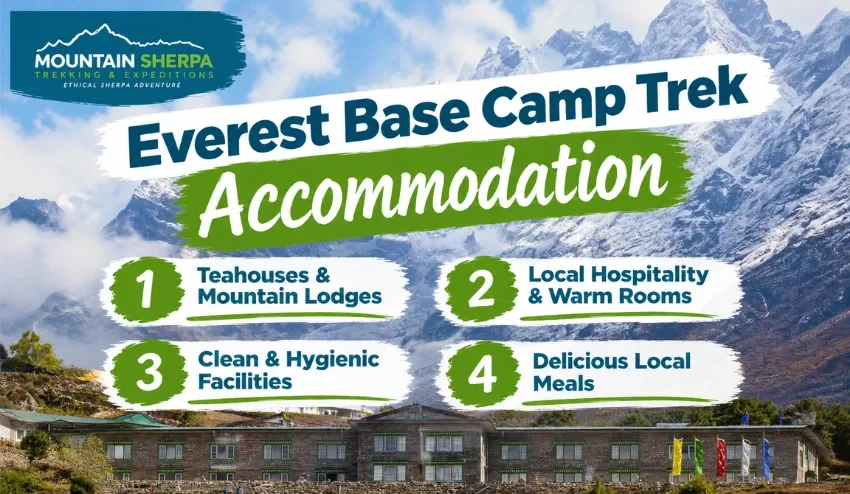
Everest Base Camp Trek accommodation is mainly provided in mountain lodges and tea houses along the Khumbu Valley. Rooms are generally simple, twin-sharing is common, and facilities vary from one village to another. As the trail climbs toward Lobuche and Gorakshep, accommodation becomes more basic because of the remote location and high altitude.
At lower elevations, trekkers can find more comfortable lodges with better bathrooms, showers, charging, and internet facilities. Higher on the route, the priority is usually having a warm, safe place to sleep after a long day of walking.
There are also different ways to experience the trek. A standard Everest Base Camp itinerary uses traditional mountain lodges, while luxury packages provide upgraded accommodation at selected locations. Some itineraries also use helicopters to reduce travel time or avoid the return trek from the Everest region.
This guide explains what you can realistically expect from EBC accommodation, including rooms, bathrooms, hot showers, Wi-Fi, charging, high-altitude lodges, and the differences between standard and luxury options.
Accommodation on the Everest Base Camp route mainly consists of locally operated tea houses and mountain lodges.
These lodges are designed around the needs of trekkers. Most have private sleeping rooms, a shared dining area and bathroom facilities. The standard of the rooms depends on the village, lodge, and altitude.
A typical trekking lodge is much simpler than a hotel in Kathmandu. Rooms are usually furnished with beds and basic bedding, while the dining area is often the warmest and most social part of the building.
Accommodation generally becomes simpler as you move higher into the Khumbu Valley. Namche Bazaar, for example, has considerably more accommodation choices than Lobuche or Gorakshep.
For travelers who want to understand the complete route before deciding on accommodation, the Everest Base Camp Trek Itinerary provides useful context about where you spend each night and how the route progresses.
|
Location |
Accommodation |
What You Can Expect |
|
Kathmandu |
Dusit Princess Kathmandu – 5-Star Hotel |
Luxury room, private bathroom, Wi-Fi, dining, pool and wellness facilities |
|
Lukla |
Mountain Hotel / Lodge |
Comfortable room, private or attached bathroom, dining facilities and mountain views |
|
Phakding |
Luxury Mountain Lodge |
Heated room, private bathroom, mountain views and electric blanket |
|
Namche Bazaar |
Luxury Lodge |
Comfortable room, dining facilities and better lodge amenities |
|
Tengboche / Deboche |
Mountain Lodge |
Simple room, basic facilities and a comfortable place to rest |
|
Dingboche |
Mountain / Comfort Lodge |
Basic comfortable room, dining area and essential facilities |
|
Lobuche |
Local Mountain Lodge |
Simple room, shared facilities and common dining area |
|
Gorakshep |
Local Mountain Lodge |
Basic room, shared bathroom and common dining area |
The exact lodge can vary according to the itinerary, season, and availability. It is therefore better to think about accommodation by type and location rather than expecting a particular hotel at every stop.
Rooms on the Everest Base Camp trek are generally simple and practical.
Twin-sharing rooms are common, particularly on organized trekking packages. Two trekkers usually share a room with separate beds, although the exact room arrangement depends on the lodge.
Beds may include mattresses, pillows, and blankets, but trekkers should still carry a suitable sleeping bag because nights can become very cold, particularly at higher elevations.
Room facilities also change with altitude. A lodge in Namche Bazaar may provide more comfortable facilities than a basic lodge in Gorakshep.
Twin-sharing is one of the most common accommodation arrangements on the EBC trek.
It is practical for trekking groups because lodge capacity is limited, especially during busy seasons. Couples or friends travelling together can usually request to share a room, subject to availability.
Private rooms are available in some lodges, particularly in larger settlements such as Namche Bazaar.
However, a private room should not be assumed throughout the entire trek. Availability depends on the lodge, season, group size, and location.
At higher-altitude villages, there are fewer lodges and fewer rooms, so accommodation choices become more limited.
Not every EBC room has an attached bathroom.
Bathroom arrangements vary considerably between lodges. Some rooms have private attached bathrooms, while others use shared bathrooms located elsewhere in the lodge.
This difference becomes more noticeable at higher elevations.
If having a private bathroom is important to you, check the accommodation details of your particular trekking package before booking. Luxury packages generally place more emphasis on rooms with attached bathrooms at selected locations, while standard trekking packages combine rooms with attached and shared bathroom facilities.
It is also worth remembering that an attached bathroom does not necessarily mean the same facilities you would expect from a city hotel. Water supply, hot water, and bathroom fittings can vary according to the lodge and altitude.
Yes, hot showers are available at many lodges, but they are not identical at every stop.
At lower and mid-altitude settlements, hot showers are generally easier to access. As you move toward Lobuche and Gorakshep, facilities become more limited.
Some lodge stays include hot showers as part of the trekking package, while independent travelers may need to pay an additional fee depending on the lodge.
Luxury trekking packages generally provide more consistent access to hot showers at selected accommodation stops.
It is better to check the specific package inclusions rather than assuming that unlimited hot water will be available throughout the trek.

Accommodation changes as the trail moves from the lower Khumbu Valley toward Everest Base Camp.
Phakding is one of the first overnight stops after Lukla.
Because it is at a relatively low elevation compared with the later trekking stops, accommodation here is generally more comfortable than at the highest villages.
Most trekkers stay in local mountain lodges with basic rooms and shared facilities, although selected packages may provide rooms with attached bathrooms.
Namche Bazaar is the main commercial center of the Khumbu region and has a wider range of accommodation than most villages farther along the route.
Trekkers can find traditional tea houses, comfortable lodges, and upgraded accommodation options.
Namche is also an important acclimatization stop, so trekkers normally spend additional time here rather than simply passing through.
For travelers planning their trip around weather and trekking conditions, the Everest Base Camp Trek Best Time guide can help explain how the trekking seasons affect accommodation demand and overall conditions.
Tengboche and nearby Deboche provide a more traditional mountain-lodge experience.
Accommodation is generally simpler than in Namche Bazaar. The surrounding environment is quieter, and the number of accommodation choices is smaller.
Because the route is already gaining considerable altitude, trekkers should focus more on warmth, rest, and practical facilities than on hotel-style comfort.
Dingboche is an important acclimatization stop on the EBC route.
Accommodation ranges from traditional mountain lodges to more comfortable lodge options depending on the package.
Some upgraded trekking packages provide rooms with attached bathrooms and hot showers here, while other travelers may stay in simpler lodge rooms.
Dingboche is also one of the places where trekkers spend time adjusting to the increasing altitude, making a comfortable night's rest particularly useful.
Lobuche is much higher and more remote than the lower villages.
As a result, accommodation becomes more basic. There are fewer lodges, fewer rooms and fewer facilities compared with Namche Bazaar or Kathmandu.
Trekkers should not expect the same level of bathroom, heating or internet facilities found at lower elevations.
The accommodation is primarily about providing a place to rest before continuing toward Everest Base Camp.
Gorakshep is one of the highest overnight settlements on the standard Everest Base Camp route.
Accommodation here is basic compared with lower villages. There are limited lodges, and demand can be high during the main trekking seasons.
This is also where expectations are important. Even on a luxury-oriented trek, the remote high-altitude environment means that accommodation at Gorakshep cannot provide the same experience as a luxury hotel in Kathmandu.
Lukla has more accommodation choices than the high-altitude villages.
Because of its lower elevation and position as the gateway to the Everest region, trekkers can generally expect more comfortable facilities here.
Depending on the itinerary, travelers may stay overnight in Lukla before flying or taking a helicopter back to Kathmandu.
Trekkers normally sleep in mountain lodges or tea houses along the Everest Base Camp route.
The most common arrangement is a simple twin-sharing room with beds and basic bedding. Bathrooms may be attached to the room or shared, depending on the lodge.
At lower elevations such as Phakding and Namche Bazaar, accommodation tends to offer more choices and facilities. At higher stops such as Lobuche and Gorakshep, rooms and facilities become more basic.
There is a noticeable difference between standard and luxury EBC trekking packages, particularly in Kathmandu and selected lower or mid-altitude lodge stays.
|
Feature |
Standard EBC Trek |
Luxury EBC Trek |
|
Kathmandu |
4/5-star hotel depending on package |
5-star hotel |
|
Mountain accommodation |
Local Sherpa mountain lodges |
Comfort/premium lodges where available |
|
Room type |
Mainly twin-sharing |
More upgraded rooms at selected stops |
|
Attached bathrooms |
Available at selected lodges |
Greater emphasis on attached bathrooms |
|
Hot showers |
Available at selected stops/package inclusions |
More consistent availability at selected lodges |
|
High-altitude accommodation |
Best available local lodge |
Best available local lodge where necessary |
|
Overall approach |
Practical mountain comfort |
Greater emphasis on comfort |
The difference does not mean that luxury accommodation provides hotel-style facilities at every point on the trail. Remote locations such as Lobuche and Gorakshep still have environmental and infrastructure limitations.
If you are comparing different itineraries, How to Choose an Everest Base Camp Trek Package can help you compare factors such as duration, transportation, accommodation and comfort.
Facilities vary significantly between locations.
Dining rooms are usually the main communal areas inside mountain lodges.
They are often where trekkers eat meals, drink tea, talk with other travelers, and spend time during cold evenings.
The dining area may feel considerably warmer than the bedrooms, so many trekkers spend much of their evening there.
Electricity is available in many lodges, but charging access is not always the same as it would be in a city hotel.
Some lodges charge separately for charging electronic devices, particularly at higher elevations.
A power bank is therefore useful for keeping your phone, camera or other small devices charged.
Wi-Fi is available at some lodges along the route, but the quality and reliability vary.
Connection generally becomes less dependable as you travel farther into the mountains.
If you need reliable internet for work, it is better to plan around the possibility of limited connectivity rather than assuming that every lodge will have fast Wi-Fi.
Mountain lodges often have a heated or warmer common dining area, particularly during the colder evenings.
Bedrooms are generally much simpler.
Do not expect central heating in every room. A suitable sleeping bag and warm clothing are more important for staying comfortable overnight.
Water can be obtained at lodges and settlements along the trekking route.
Trekkers should follow local guidance and use an appropriate purification or treatment method when necessary.
A reusable water bottle or hydration system is useful throughout the trek.
Yes, accommodation generally becomes more basic as the EBC route gains altitude.
This happens because:
This is particularly noticeable after Dingboche.
By the time you reach Lobuche and Gorakshep, accommodation should be viewed as practical high-altitude shelter rather than conventional hotel accommodation.
A few simple habits can make lodge nights more comfortable.
Good preparation is especially important at higher elevations, where cold temperatures and basic rooms can make sleeping more difficult.
You do not need to carry a huge collection of accommodation-specific equipment, but several small items are useful.
A complete Everest Base Camp Trek Packing List can help you prepare the rest of your trekking gear, clothing and personal items.
Most established lodges along the main EBC route regularly accommodate trekkers, but cleanliness and facilities can vary from one lodge to another.
It is better to expect practical mountain accommodation rather than hotel-level standards.
You can also take simple steps to maintain personal hygiene:
If hygiene and bathroom privacy are major concerns, ask about the exact accommodation arrangements before booking your trek.
Booking accommodation in advance is useful during the main trekking seasons.
Popular settlements can become busy, and higher-altitude villages have fewer lodges and rooms available.
Organized trekking packages generally arrange accommodation as part of the itinerary, which means trekkers do not normally need to search for a room after arriving at each village.
Independent trekkers have more responsibility for finding accommodation themselves.
The situation can be particularly serious around Namche Bazaar, Dingboche, Lobuche and Gorakshep because the number of available rooms becomes increasingly limited farther up the route.
Accommodation is only one part of preparing for a high-altitude trek.
Travel insurance is also important because the Everest region is remote and evacuation or unexpected travel expenses can be significant.
Before travelling, check whether your policy covers high-altitude trekking at the maximum elevation included in your itinerary, as well as emergency evacuation and other relevant trekking risks.
For a more detailed overview of what to check before purchasing a policy, see Nepal Travel Insurance.
Not every Everest Base Camp trek follows exactly the same route or uses the same accommodation standard.
The standard Everest Base Camp Trek follows the classic route through the Khumbu Valley and uses mountain lodges along the trekking section.
This is the traditional option for travelers who want to trek to Everest Base Camp and return through the same general route.
The Luxury Everest Base Camp Trek combines the classic EBC experience with upgraded accommodation.
It uses 5-star accommodation in Kathmandu and selected comfort lodges during the trek, although the highest settlements still require the best available local accommodation.
The Luxury Everest Base Camp Trek With Helicopter Return combines upgraded accommodation with a helicopter return from the Everest region.
This reduces the amount of trekking required after reaching the main EBC and Kala Patthar section.
The Everest Base Camp Trek With Round-Trip Helicopter uses helicopter transportation for the Kathmandu-Lukla-Kathmandu sections while retaining the trekking experience in the Khumbu.
Accommodation remains primarily lodge-based along the trekking route.
The Everest Base Camp Trek Without Lukla Flight uses an overland approach instead of the usual Lukla flight.
The accommodation remains based around local mountain lodges as the route enters the Everest region.
The Everest Base Camp + Gokyo + Cho La Pass Trek combines EBC with Gokyo Valley and the Cho La Pass.
Because the itinerary extends beyond the classic EBC route, accommodation conditions can vary more significantly between villages.
The Gokyo Valley + Ama Dablam Base Camp + Everest Base Camp Trek combines several Everest-region destinations.
Accommodation is primarily provided in local mountain lodges and tea houses along the extended route.
The Everest High Pass Trek is a longer and more demanding itinerary that crosses high mountain passes.
Accommodation becomes particularly basic in remote settlements. Trekkers should therefore expect fewer facilities than on the lower sections of the standard EBC route.
Accommodation is not simply about where you sleep.
After several hours of walking at altitude, having a place to rest, eat, and stay warm becomes an important part of the trekking experience.
Accommodation can affect:
For this reason, accommodation should be one of the factors you consider when comparing EBC trekking packages.
Everest Base Camp Trek accommodation changes considerably as you move through the Khumbu Valley.
At lower elevations, you can expect more lodge choices, better facilities and greater room comfort. Higher up, accommodation becomes simpler because of the altitude, remote location, and limited infrastructure.
Most trekkers stay in mountain lodges or tea houses, with twin-sharing rooms being common. Attached bathrooms and hot showers are available at selected lodges, while facilities become more basic around Lobuche and Gorakshep.
When choosing an itinerary, consider more than just the number of trekking days. Look at the accommodation standard, bathroom arrangements, transportation, altitude profile, and how much comfort you want during the trek.
The right package for you will depend on your preferred trekking style, budget, schedule, and expectations for accommodation.
Trekkers usually stay in local mountain lodges and tea houses along the Khumbu route. Common overnight stops include Phakding, Namche Bazaar, Dingboche, Lobuche and Gorakshep. The Everest Base Camp Trek Itinerary shows the main overnight stops along the route.
Yes, hotels are available in Kathmandu and some larger settlements such as Lukla and Namche Bazaar. Farther along the trail, accommodation mainly consists of mountain lodges and tea houses, with facilities becoming simpler at higher elevations.
Yes, some EBC lodges offer private rooms, particularly in larger villages. However, private rooms are not guaranteed at every stop. Twin-sharing rooms are more common on organized treks, especially at higher elevations where accommodation choices are limited.
Some lodges have attached bathrooms, but they are not available in every room. Bathroom facilities vary by lodge and altitude. If a private bathroom is important to you, check the accommodation details of your chosen EBC package before booking.
Yes, hot showers are available at many lodges, but availability varies by location and package. Some lodges may charge separately for hot showers. Luxury EBC packages generally provide more consistent access to hot showers at selected accommodation stops.
Yes, Wi-Fi is available at some EBC lodges, but the connection can become less reliable at higher elevations. Some lodges may charge an additional fee. Trekkers should not expect consistent high-speed internet throughout the entire route.
Yes, many lodges provide charging facilities, although availability and fees vary. Charging can become more limited at higher elevations, so carrying a power bank is recommended for phones, cameras, and other small devices.
Gorakshep accommodation is basic compared with lower villages because it is one of the highest overnight stops on the EBC route. Rooms are simple, and lodge choices are limited. Trekkers should expect practical high-altitude accommodation rather than hotel-style facilities.
Yes, a suitable sleeping bag is recommended for the EBC trek because temperatures can become very cold at higher elevations. Your packing plan should also include warm sleepwear and socks. See the Everest Base Camp Trek Packing List for a more complete checklist.
Yes, luxury EBC packages are available with upgraded hotels in Kathmandu and more comfortable mountain lodges at selected stops. However, even luxury itineraries use the best available local lodges at some high-altitude locations where accommodation options are limited.
It is better to arrange accommodation in advance during the main trekking seasons because popular lodges can become busy. The Everest Base Camp Trek Best Time guide explains the main trekking seasons and conditions.
Yes. Accommodation generally becomes simpler as you climb higher. Lobuche and Gorakshep have fewer lodges and more limited facilities than places such as Namche Bazaar because of the altitude, remote location, and limited infrastructure.
Choosing the right accommodation can make a significant difference to your trekking experience. Whether you prefer a practical lodge-based trek, upgraded accommodation or a helicopter-assisted itinerary, it helps to compare the available options before booking.
If you are unsure which itinerary or accommodation level fits your travel plans, speak with an experienced local trekking team about the route, lodge facilities, bathroom options, and available EBC packages.
Talk to an Everest Trekking Expert for personalized advice and more details about your Everest Base Camp Trek.