
-
Sumba Sherpa (Co-Founder & CEO)
+977-9849643731
Since 1998 15,000+ Happy Guests Sherpa Owned & Operated Company
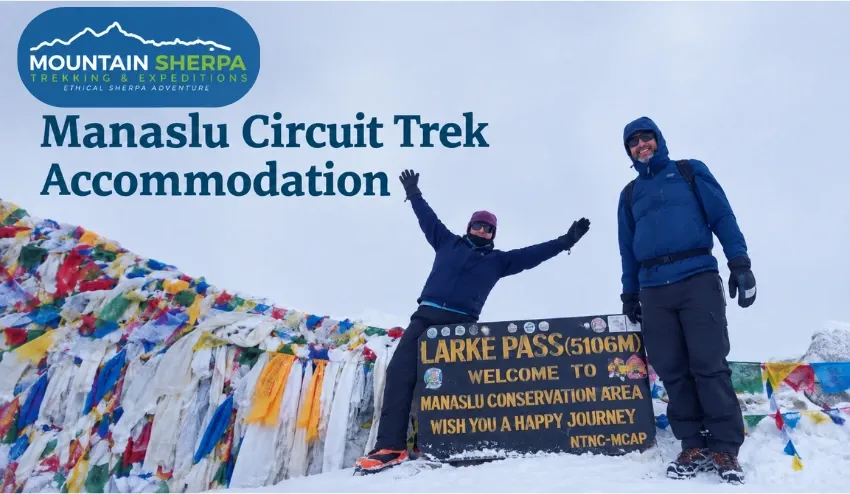
Manaslu Circuit Trek accommodation ranges from comfortable city hotels in Kathmandu to simple mountain lodges in remote Himalayan villages. As the trail climbs higher, accommodation becomes more basic, especially around Samdo and Dharamsala before crossing Larkya La Pass.
For travelers booking the trek with Mountain Sherpa Trekking, the current 17-day package includes 3 nights in a premium 4- or 5-star hotel in Kathmandu and 13 nights in the best available Sherpa mountain lodges. The package also includes 5 nights in rooms with attached bathrooms and daily hot showers during the trek.
The accommodation experience is different at each stop, so knowing what to expect can make planning your trek much easier.
|
Area |
Typical Accommodation |
What to Expect |
|
Kathmandu |
Premium 4/5-star hotel |
Modern rooms and full hotel facilities |
|
Sotikhola |
Mountain lodge/hotel |
Simple and comfortable |
|
Khorlabesi |
Local lodge |
Basic mountain accommodation |
|
Jagat |
Local lodge |
Simple trekking accommodation |
|
Deng |
Local lodge |
Practical mountain facilities |
|
Namrung |
Mountain lodge |
Comfortable lodge setting |
|
Shyala |
Local lodge |
Basic high-altitude accommodation |
|
Samagaon |
Mountain lodge |
Better-developed high-altitude village accommodation |
|
Samdo |
Local lodge |
Simple rooms and limited facilities |
|
Dharamsala |
High-altitude guesthouse/shelter |
Very basic accommodation |
|
Bimthang |
Guesthouse/lodge |
More comfortable after Larkya La |
|
Tilche |
Local lodge |
Simple village accommodation |
|
Besisahar |
Lodge/hotel |
More comfortable before returning to Kathmandu |
Accommodation standards can vary depending on the village, season, and availability. At higher elevations, trekkers should expect fewer facilities and simpler rooms.

Most nights on the Manaslu Circuit are spent in mountain lodges, tea houses or local guesthouses. These properties are built around the needs of trekkers and generally provide a room, bed, meals, and basic bathroom facilities.
The accommodation is practical rather than luxurious.
Lower villages usually have more facilities and accommodation choices. As the trail moves toward Samagaon, Samdo and Dharamsala, the number of available lodges decreases and the facilities become more basic.
This is particularly noticeable before Larkya La Pass, where the remote location and high altitude limit accommodation options.
Mountain lodges and tea houses are the standard accommodation along much of the Manaslu route.
Rooms are generally simple, with basic beds and mattresses. Many lodges also have a communal dining area where trekkers eat meals and spend time after a day of walking.
Some villages have small guesthouses or locally operated hotels rather than larger trekking lodges.
These properties provide a practical place to rest without offering the facilities of a city hotel.
The biggest change comes at the highest overnight stops.
Dharamsala, also known as Larke Phedi, is a particularly basic overnight stop before the Larkya La crossing. The current Mountain Sherpa Trekking itinerary describes the accommodation here as a stone guest house/shelter, so travelers should not expect hotel-style rooms or extensive facilities at this point.
Rooms on the Manaslu Circuit are generally simple and designed for trekkers who need a place to rest after several hours of walking.
Depending on the lodge and location, rooms may include:
Room standards are not the same throughout the route.
Accommodation in Kathmandu provides a much higher level of comfort than a remote mountain lodge. Similarly, a lodge in a lower village may offer more facilities than the accommodation at Dharamsala.
For this reason, it is better to think of Manaslu accommodation as comfortable where the route allows it and basic where the altitude and remoteness require it.
Private rooms may be available at some lodges, but they cannot be guaranteed at every stop.
Twin-sharing accommodation is common on trekking routes, particularly when accommodation choices are limited. During busy trekking seasons, room availability can also be affected by the number of trekkers staying in a village.
At remote high-altitude locations, there may be fewer room choices than at places such as Kathmandu, Namrung or Samagaon.
If having a private room is important to you, discuss this with your trekking company before departure so the accommodation arrangements are clear.
Some Manaslu lodges have attached bathrooms, but not every room does.
Bathroom facilities vary considerably along the route. Some lodges offer rooms with attached bathrooms, while others use shared bathroom facilities.
For the current Mountain Sherpa Trekking package, 5 of the mountain-lodge nights are in rooms with attached bathrooms.
This should not be interpreted as every lodge having an attached bathroom. Facilities depend on the location and available accommodation.
At higher elevations, particularly around Dharamsala, bathroom facilities are much more basic.
Yes. However, hot shower facilities on a Himalayan trekking route are different from using a hotel bathroom in Kathmandu. Availability depends on the lodge's infrastructure, and facilities become simpler in remote and high-altitude areas.
A hot shower can also feel especially valuable after a long day of trekking, particularly in colder sections of the route.
If you are trekking independently, check the shower facilities and additional charges at individual lodges before using them.

Accommodation changes noticeably as you move through the Manaslu region. Here is what to expect at the main overnight stops.
The Manaslu Circuit journey begins and ends in Kathmandu.
Mountain Sherpa Trekking's current package includes 3 nights in a centrally located premium 4- or 5-star hotel.
Compared with the mountain lodges, Kathmandu accommodation provides modern hotel facilities and a more comfortable place to prepare for the trek and recover after returning from the mountains.
Sotikhola is one of the first overnight stops after leaving the Kathmandu Valley.
Mountain Sherpa Trekking's current itinerary lists Chhum Valley Hotel or Green Valley Hotel for this night.
Accommodation here is still relatively simple, but it provides a comfortable base before the trek moves deeper into the Manaslu region.
Khorlabesi is another village stop where trekkers stay in the best available local lodge.
Facilities are practical and suited to trekkers rather than luxury travelers.
As the route moves farther from the road-accessible lower sections, accommodation gradually becomes more basic.
Jagat is another important overnight village on the Manaslu Circuit.
The itinerary uses the best available local lodge here. Rooms are generally simple, with the facilities travelers need for an overnight stay.
Jagat is also one of the settlements where the character of the Manaslu trekking route becomes more apparent.
Mountain Sherpa Trekking lists Shangri-La Home Hotel or a similar property for the Deng overnight stay.
By this point, the route is moving farther into the mountain region, and accommodation follows the traditional trekking-lodge style.
You should expect a comfortable place to sleep and eat rather than city-style hotel facilities.
Namrung is one of the higher villages along the route.
The current itinerary lists River Side Cottage or a similar lodge.
Accommodation remains relatively comfortable compared with the higher settlements farther along the trail, although facilities are still those of a mountain lodge.
Shyala is a high-altitude settlement surrounded by impressive Himalayan scenery.
Accommodation choices are more limited than in larger settlements, and travelers should expect simpler facilities.
Samagaon is one of the most important accommodation stops on the Manaslu Circuit.
The itinerary lists Hotel Norling or a similar property for this section of the trek.
The current itinerary includes time for acclimatization in Samagaon, so trekkers spend more time here than at many other stops.
Because Samagaon is a larger settlement than some of the higher villages, accommodation is generally more developed than what you will find farther up the route.
After Samagaon, the trail continues toward Samdo.
The itinerary lists Yak Hotel or a similar property for accommodation here.
At this altitude, accommodation becomes noticeably more basic. The number of available facilities is limited, and trekkers should be prepared for a colder and simpler environment.
Dharamsala, also known as Larke Phedi, is one of the most basic accommodation points on the Manaslu Circuit.
The current itinerary describes the accommodation as a stone guest house/shelter.
This is the final overnight stop before crossing Larkya La Pass, so the focus here is mainly on resting before the early start.
Do not expect hotel-style comfort at Dharamsala. The high altitude, remote location, and limited infrastructure naturally mean fewer facilities.
After crossing Larkya La Pass, trekkers descend toward Bimthang.
The current itinerary lists Apple Garden Guest House or Tibet Guest House.
The accommodation experience generally becomes more comfortable after leaving the highest section of the route behind.
Bimthang is therefore an important transition point between the high-altitude section and the lower parts of the circuit.
Tilche is another village accommodation stop before the journey continues toward Besisahar.
The itinerary uses the best available local lodge here.
Facilities are simpler than a city hotel but suitable for a final mountain-region overnight stay.
Besisahar marks the transition back toward more developed areas.
The itinerary uses the best available lodge with clean and comfortable rooms for the Besisahar stay.
After several nights in mountain lodges, this stop provides a more comfortable environment before continuing back toward Kathmandu.
Yes. Accommodation generally becomes more basic as the Manaslu Circuit gains altitude.
This change in accommodation is also one of the practical factors to consider when preparing for the trek. If you want to understand the physical demands of the route, see our Manaslu trek difficulty guide.
There are several reasons for this:
The change becomes particularly noticeable along the progression from Namrung to Shyala, Samagaon, Samdo and Dharamsala.
This is why travelers should not expect the same room and bathroom standards at Dharamsala as they would in Kathmandu or lower villages.
Dharamsala is the final overnight point before the Larkya La crossing.
Because it sits at a high altitude and has limited infrastructure, accommodation here is much more basic than at lower villages.
Trekkers generally arrive, have dinner, prepare their gear and rest before an early start for the pass.
The important thing is to understand that Dharamsala is not a comfort-focused overnight stop. Its purpose is to provide a place to rest before the demanding high-altitude crossing.
After crossing Larkya La, the descent toward Bimthang brings a noticeable change in the accommodation environment.
Facilities vary from lodge to lodge, but most mountain accommodation is organized around a few basic needs.
Dining rooms are an important part of lodge life.
They are where trekkers eat, warm up, talk with other travelers, and spend time after a day on the trail.
At higher elevations, the dining area can also be one of the more comfortable communal spaces in the lodge.
Electricity and charging facilities vary along the Manaslu route.
Mountain Sherpa Trekking's package information treats phone, internet, and battery charging as additional expenses, so travelers should not assume that charging is always free.
Carrying a power bank is useful, particularly for longer days away from reliable electricity.
Internet connectivity varies considerably along the route.
You may find Wi-Fi or mobile connectivity in some villages, while higher and more remote locations can have limited or unreliable service.
If staying connected is important, download important information, maps and documents before entering the more remote sections.
Heating facilities vary between lodges.
Common dining areas may provide a warmer place to sit, while bedrooms can be considerably colder, especially at higher elevations.
A good sleeping bag and warm sleeping layers are therefore important.
Hot showers are included daily in the current Mountain Sherpa Trekking package.
However, shower facilities naturally become simpler in remote locations, and independent trekkers should check individual lodge arrangements.
The answer depends on where you are on the route.
Accommodation is also one of the factors that can differ between Himalayan trekking routes. If you are comparing two popular high-altitude treks, our Manaslu Circuit vs Everest Base Camp guide explains the key differences.
In Kathmandu, you can expect premium hotel accommodation.
In lower and middle sections of the circuit, mountain lodges provide a practical and reasonably comfortable place to sleep.
As the trail climbs higher, accommodation becomes simpler.
At Dharamsala, for example, the priority is having a place to rest before crossing Larkya La rather than having extensive facilities.
This is normal for a remote Himalayan trekking route.
The key is to choose a trekking company that understands the route and arranges the best available accommodation according to each location.
A few items can make mountain-lodge stays much more comfortable.
Consider packing:
You do not need to carry full hotel-style supplies. Keep your personal items compact because space and luggage weight matter on a multi-day trek.
Mountain Sherpa Trekking also provides a warm sleeping bag and down jacket for complimentary use if needed, according to the current package information. These items are returned after the trek.
If you are preparing your gear, a detailed Manaslu Circuit Trek Packing List can help you decide what to carry without overpacking.
Mountain Sherpa Trekking's current Manaslu Circuit package is designed around a combination of comfortable city accommodation and locally operated mountain lodges.
The package includes:
The package includes:
The exact lodge used can depend on availability at each location.
This is particularly important in remote areas where there may be only a limited number of accommodation options.
MSTE uses the best available local accommodation rather than promising luxury facilities at every stop.
This is a more realistic approach for a route that includes remote settlements such as Samdo and Dharamsala.
If you are comparing different Himalayan trekking routes, the Manaslu Circuit vs Annapurna Circuit guide can help you understand how the two trekking experiences differ.
Accommodation is more than just a place to sleep.
After several hours of walking each day, a warm dining area, a clean room, and reliable lodge arrangements can make a noticeable difference to your trekking experience.
It is particularly important on the Manaslu Circuit because the route moves from relatively developed areas into remote high-altitude settlements.
Accommodation is only one part of preparing for a successful trek. Proper preparation, acclimatization, packing, and choosing the right trekking support are also important. See our guide on What's vital for a successful Manaslu Circuit Trek for more practical tips
Mountain Sherpa Trekking has been operating since 1998 and uses local Sherpa trekking expertise to organize accommodation, guides, transportation, and other logistics along the route.
For travelers who want to understand the complete route, including daily walking distances, overnight stops, and acclimatization, the Manaslu Circuit Trek Itinerary provides a useful overview before booking.
It is also worth considering the best time to trek the Manaslu Circuit, since the season can affect accommodation availability, weather conditions, and the overall experience on the trail.
For a complete understanding of the trek, including the route, inclusions, and current package details, visit the Manaslu Circuit Trek page.
You stay in mountain lodges, tea houses, and local guesthouses along the route, with premium 4- or 5-star hotel accommodation in Kathmandu.
Yes, but comfort varies by location. Lower villages generally have more facilities, while higher stops such as Samdo and Dharamsala are more basic.
Some do, but not every room has one. The current MSTE package includes 5 nights in rooms with attached bathrooms.
Yes. The current MSTE package includes daily hot showers during the trek, although facilities become more basic at higher elevations.
Samagaon has relatively well-developed mountain lodges compared with the higher villages. It is also an important acclimatization stop on the route.
Accommodation at Samdo is simple, with basic mountain-lodge facilities. The current itinerary lists Yak Hotel or a similar property.
Dharamsala is one of the most basic overnight stops. It has a stone guesthouse or shelter and is mainly used for resting before crossing Larkya La Pass.
Private rooms may be available at some lodges, but they cannot be guaranteed at every stop, especially during busy seasons or at higher elevations.
Bring warm sleeping clothes, a sleeping bag, toiletries, a headlamp, power bank, and other essential trekking gear. See the Manaslu Circuit Trek Packing List for a complete checklist.
Yes. The package includes 3 nights in Kathmandu and 13 nights in the best available Sherpa mountain lodges during the trek.
Both use mountain lodges, but accommodation options can differ by location. The Manaslu Circuit vs Annapurna Circuit comparison explains the accommodation differences in more detail.
Yes. Accommodation generally becomes simpler as you climb higher because remote villages have fewer lodges and limited infrastructure.
Knowing what to expect from Manaslu Circuit Trek accommodation can make the planning process much easier. The route combines comfortable hotel stays in Kathmandu with practical mountain lodges and increasingly basic accommodation as you approach Larkya La Pass.
If you prefer more comfort, want to understand the bathroom and shower arrangements, or simply want to know what to expect at each overnight stop, it is worth discussing your preferences before booking.
Talk to a Manaslu Trekking Expert